Built the first-ever web presence for a 30-year boutique executive recruiter in the HVAC and building automation space. No existing site, no brand assets, no playbook — just a very clear business model and two very different audiences to serve.
View Live Site →Overview
30 years of expertise, zero web presence
Strategic Search Partners had built an impressive track record placing executives across HVAC, building automation, and manufacturing — entirely through relationships. The website was the missing piece.
The situation
The owner had 30 years of industry experience, 400+ successful placements, and a rolodex that spanned North America, Europe, and Asia. What he didn't have was a website.
New business was coming in, but international companies finding him through search had nowhere to land. There was nothing to validate the business, explain the model, or give candidates a way to get on his radar.
Constraints that shaped everything
- One-person operation — had to be maintainable without a developer
- No CRM (Customer Relationship Management software) — runs on Microsoft tools, folders, and contacts. No Salesforce, no applicant tracking system
- Two very different audiences — employers and candidates need completely different things
- Boutique positioning — had to feel like an expert, not a job board
- 5 week timeline — solo project, needed to ship fast
How do you build a website that establishes 30 years of credibility in seconds, serves two fundamentally different audiences without confusing either, and plugs directly into an existing one-person workflow — all without a CRM or backend database?
What success looked like
Primary goals
- Establish credibility immediately — experience, placements, industries served
- Create distinct paths for employers vs. candidates so neither gets confused
- Make it dead simple for candidates to submit a resume
Secondary goals
- Communicate the passive candidate sourcing model clearly — that's what differentiates this firm from a job board
- Build specialty pages that speak directly to each industry segment
- Keep everything maintainable by one non-technical person
Research
Understanding the business before touching a wireframe
Spent significant time with the owner before designing anything. The business model is specific enough that getting it wrong in the design would undermine everything.
Deep-dive interviews with the business owner to map the model, understand both audiences, and identify technical constraints. Followed by competitive analysis of similar boutique executive recruitment firms to find where SSP could stand apart.
How the business actually works
The model in plain English
Strategic Search Partners finds executives and technical professionals for companies in HVAC, building automation, manufacturing, and food service. The firm works with three types of organizations: manufacturers, independent sales representatives, and distributors.
The key differentiator: 90% of placements come from passive candidates — people currently employed who aren't applying for jobs but are open to the right opportunity. That's not a job board. That's a fundamentally different service, and the site had to make that clear.
Two audiences, completely different needs
The hiring executive
Typically a VP or C-suite leader at an HVAC, building automation, or manufacturing company. Frustrated with low-quality applicants from job postings and needs someone who can proactively surface people working at competitors.
- Fast read on what industries the firm covers
- Confidence the recruiter actually knows their space
- Understanding of how passive sourcing is different
- Easy way to schedule a conversation
The passive candidate
Currently employed as a sales engineer, regional manager, or executive. Not actively job hunting, but open to a step up. Wants to get on the recruiter's radar without filling out a 20-field application form.
- Simple resume drop — name, email, phone, file attachment
- Clear picture of what roles and industries are covered
- Confirmation that submission went through
- Direct contact info if they want to follow up
Unlike a consumer product that needs maximum traffic, this is a business development tool for a high-value, low-volume business. The owner already knows most of the major players. The site exists primarily to capture inbound from international companies in Asia, Europe, and emerging markets who find SSP through search. Success is attracting the right five leads — not maximizing session count.
Technical reality check
What he actually uses
The owner runs his entire operation on Microsoft tools — Outlook for email, Word documents for candidate profiles, organized folders backed up in multiple locations. No Salesforce. No applicant tracking system. No CRM.
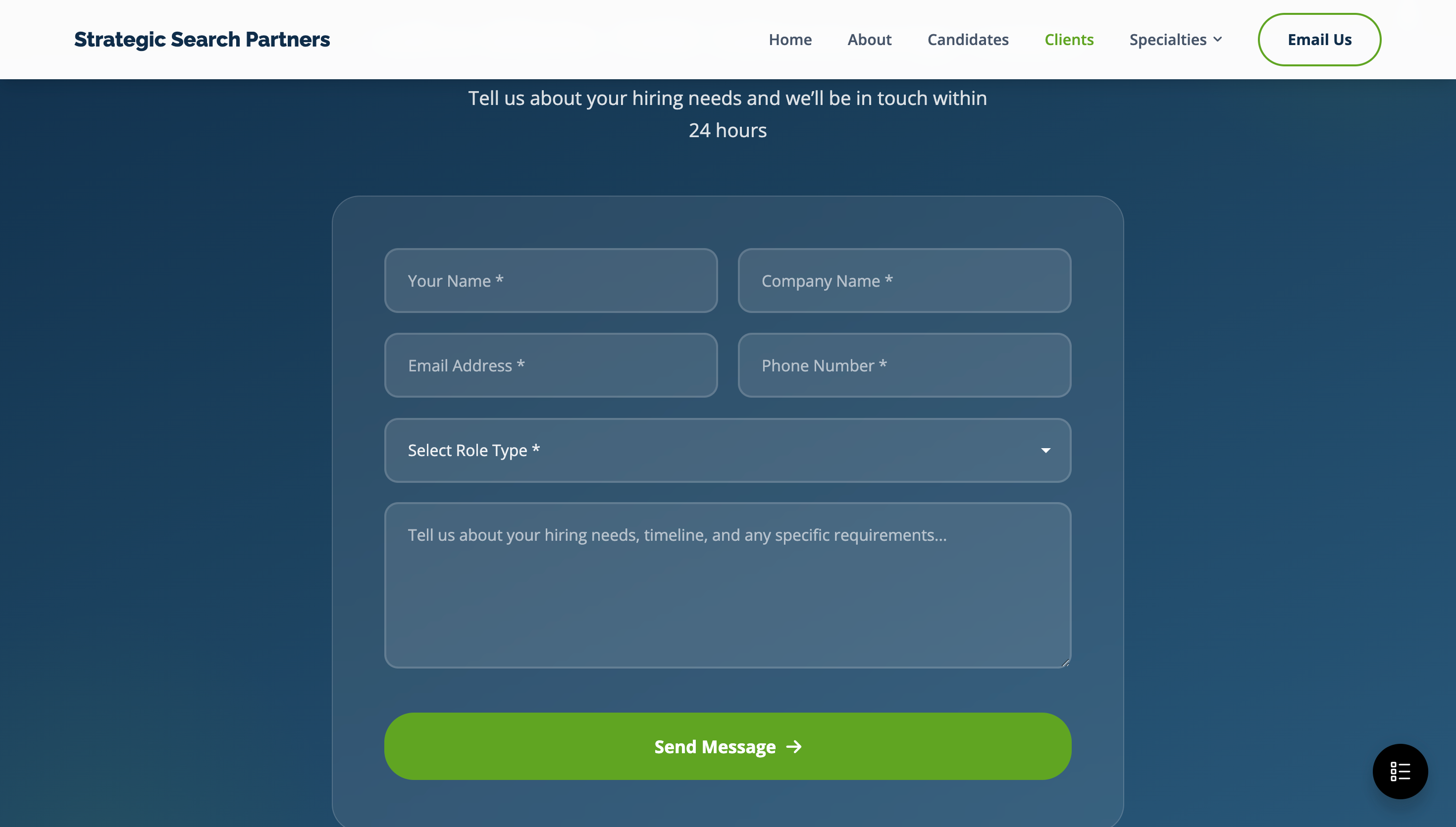
Any contact form needed to drop submissions directly into his email inbox. No middleware, no database sync, no third-party platform requiring a separate login.
Competitive landscape
Most boutique executive recruitment sites in this space suffer from the same problems: generic corporate templates, no personality, and zero explanation of what makes them different from LinkedIn or a staffing agency.
The opportunity was to lead with the passive candidate model and deep industry knowledge — two things no one else was communicating clearly.
Industries to cover
Each specialty needed its own page with tailored messaging — not just a line item on a list.
Key Decisions
What got built, what got cut, and why simplicity won
Every decision came back to one question: does this fit how a one-person operation actually runs?
What I built
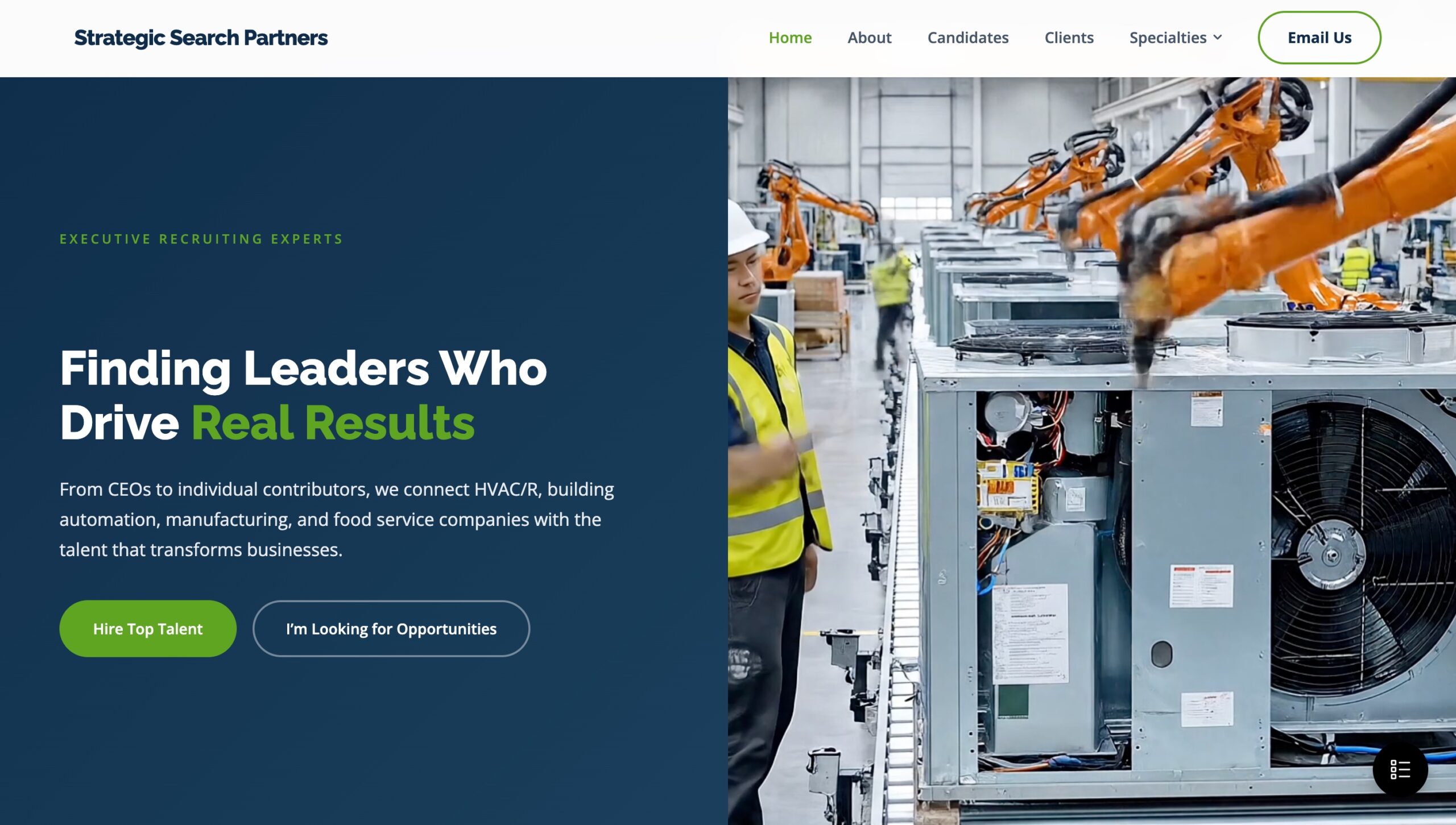
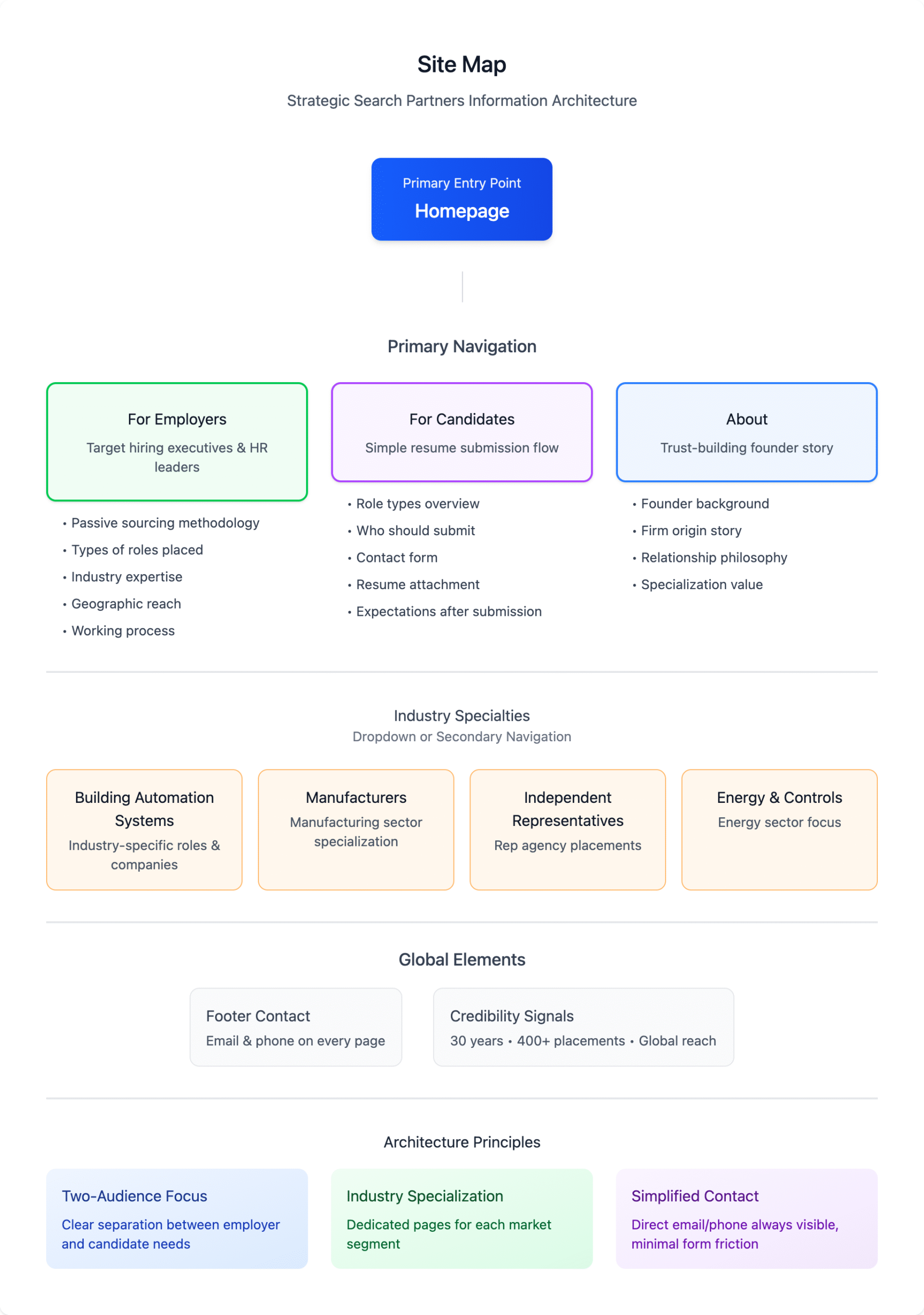
Dual audience architecture — separate employer and candidate paths
Employers and candidates need completely different information and actions. Forcing them through the same flow creates confusion and increases drop-off. Hard split in the navigation and on the homepage so each audience lands somewhere relevant immediately.
Email-based contact system via FormSubmit — no database
The owner's entire workflow runs on Outlook. Building a form that drops into his inbox means zero behavior change on his end. FormSubmit handles the routing, supports file attachments for resumes, and requires no backend. Fits perfectly into his existing Microsoft-based system.
8 industry specialty pages with tailored content
Generic "industries we serve" lists don't build trust with technical buyers. A VP of Engineering at a chiller manufacturer needs to see that you understand their world specifically — the equipment, the roles, the organizational structure. One page per specialty makes that possible.
Credibility signals front-loaded — 30 years, 400+ placements, international reach
A boutique one-person firm competes on trust. The numbers and depth of experience need to hit immediately, not buried in an About page. Homepage hero, footer, and every key landing page surfaces these signals.
WordPress + Kadence — no custom development
The owner needs to update content — swap a specialty page, change contact info, add a new industry — without calling a developer. Kadence gives a clean professional look with full visual editing. The right call at this scale.
What got cut and why
Applicant tracking system (ATS) integration
Would create a parallel system competing with his existing folder-based workflow. The owner would have to manage two places where candidate info lives. At 400+ placements with an existing system that works, that's a problem, not a feature. No ROI at this scale.
Candidate portal / login area
Passive candidates aren't checking a portal — they submitted their resume and are waiting for a call. A login area adds friction to the submission flow and maintenance overhead with minimal upside. Email confirmation is enough.
Automated scheduling tool (Calendly-style)
Executive recruiting relationships are high-touch. Sending a hiring VP to a calendar link instead of a personal email or phone call signals the wrong thing about how this firm operates. Direct contact info on every page is the right move.
Job board / open positions listing
90% of placements come from passive candidates who aren't browsing job listings. Publishing open roles would confuse the positioning — SSP is not a job board, and the site should never look like one.
The best solution wasn't the one with the most features. It was the one that fit seamlessly into how the business already operates. A fancy applicant tracking system would've impressed nobody and created daily maintenance headaches for someone running a one-person operation.
Messaging decisions
Lead with passive sourcing
The "90% passive candidates" stat is the clearest differentiator from job boards or big staffing agencies. It leads on the homepage hero, the employers page, and every specialty page. If a visitor misses that, the site has failed.
Industry-specific language
Writing copy that mentions chillers, air handlers, building management systems, and HVAC/R signals insider knowledge immediately. Generic recruiting language would undermine 30 years of credibility in one paragraph.
International reach as a signal
North America, Europe, Asia, Latin America — the geographic breadth matters because the primary growth opportunity is inbound from international companies finding SSP through search. That reach needed to be visible.
Deliverables
A complete web presence built from scratch in 5 weeks
Everything from site architecture to copywriting to the live WordPress build.
Pages built
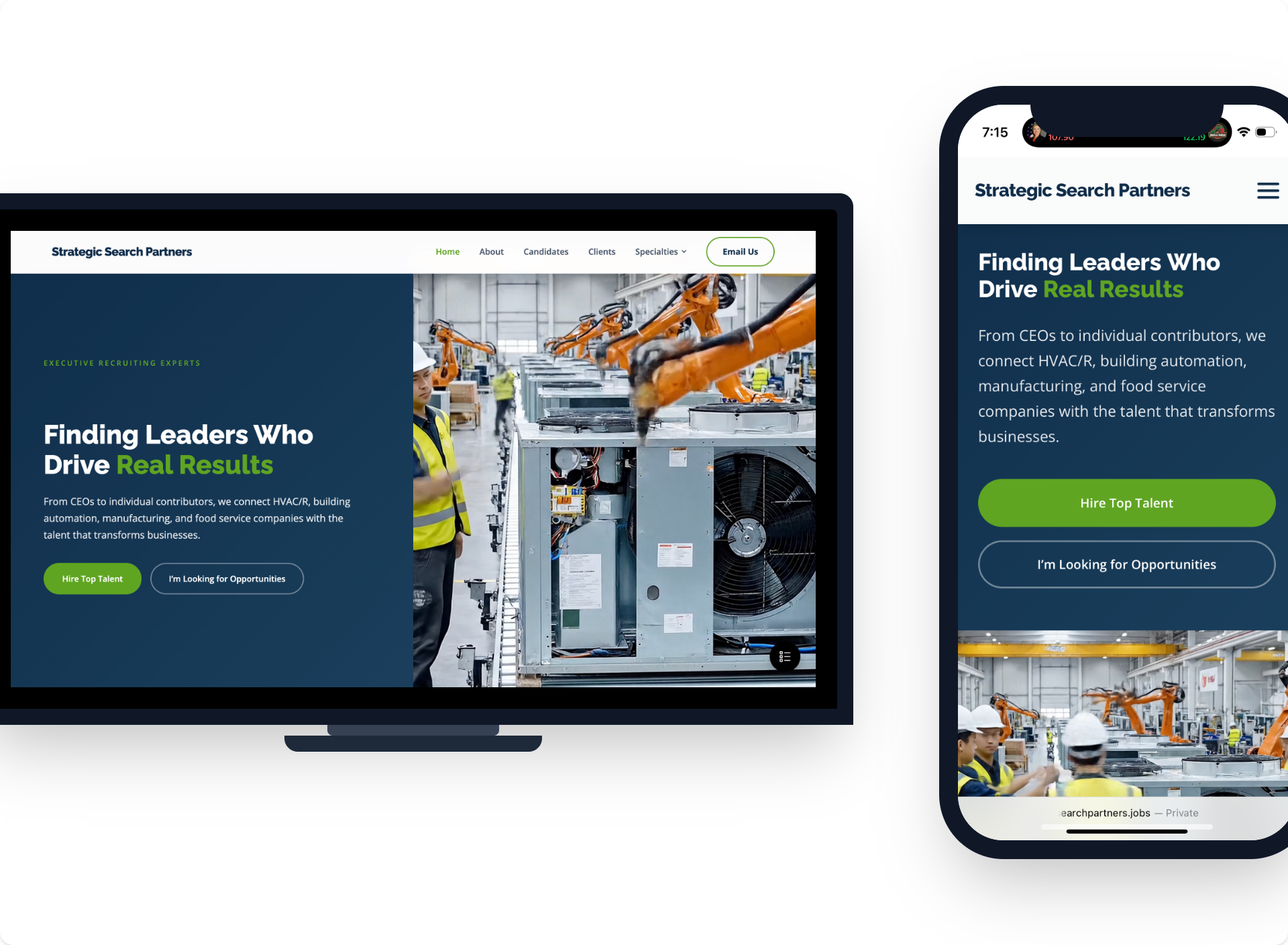
- Homepage — value proposition, stats, dual audience CTAs
- Employers page — services, placement process, industry expertise
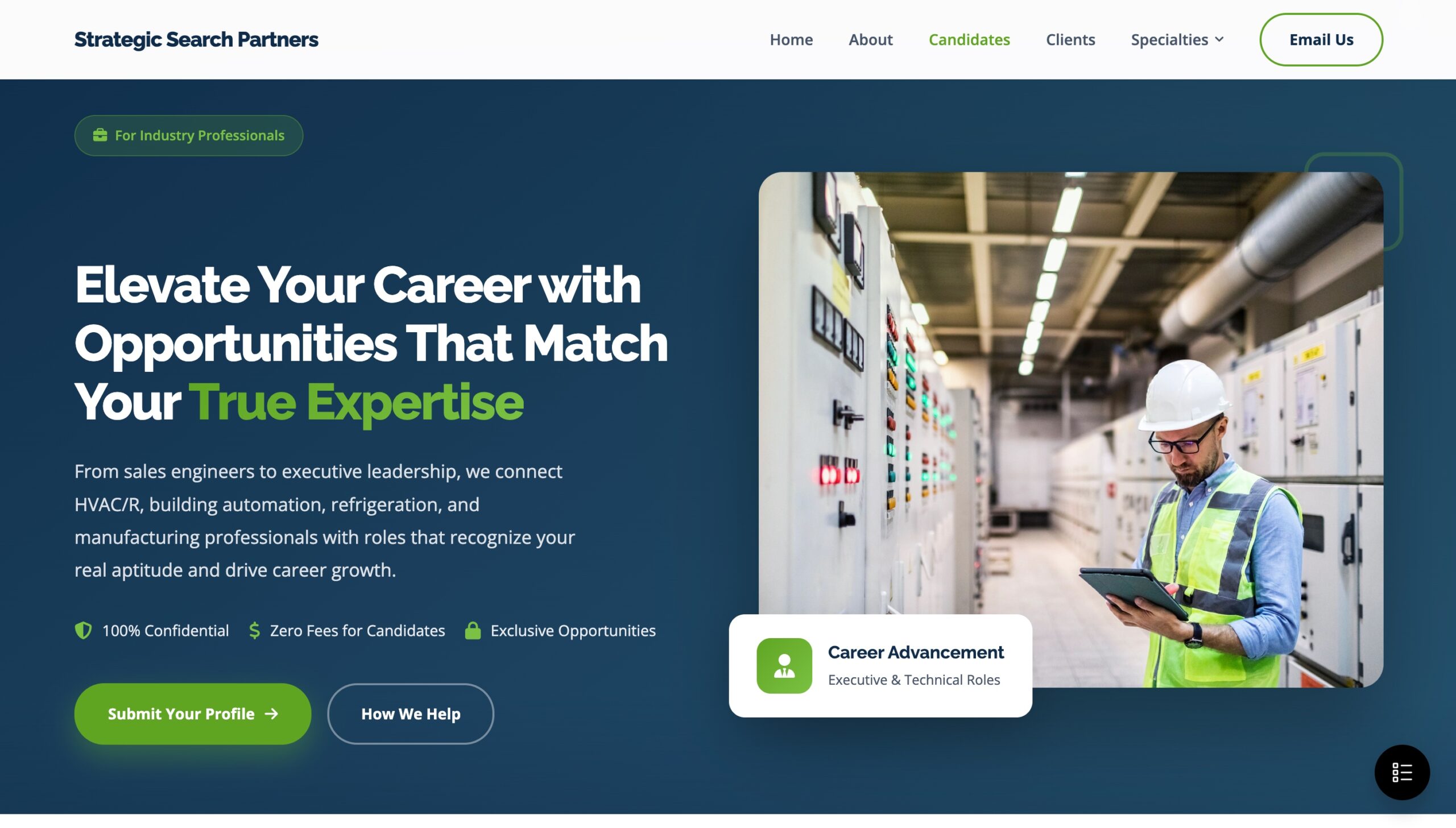
- Candidates page — resume submission form with file attachment
- About page — founder background, company story, approach
- 8 specialty pages (see below) — tailored content per segment
Supporting work
- Full site map and information architecture
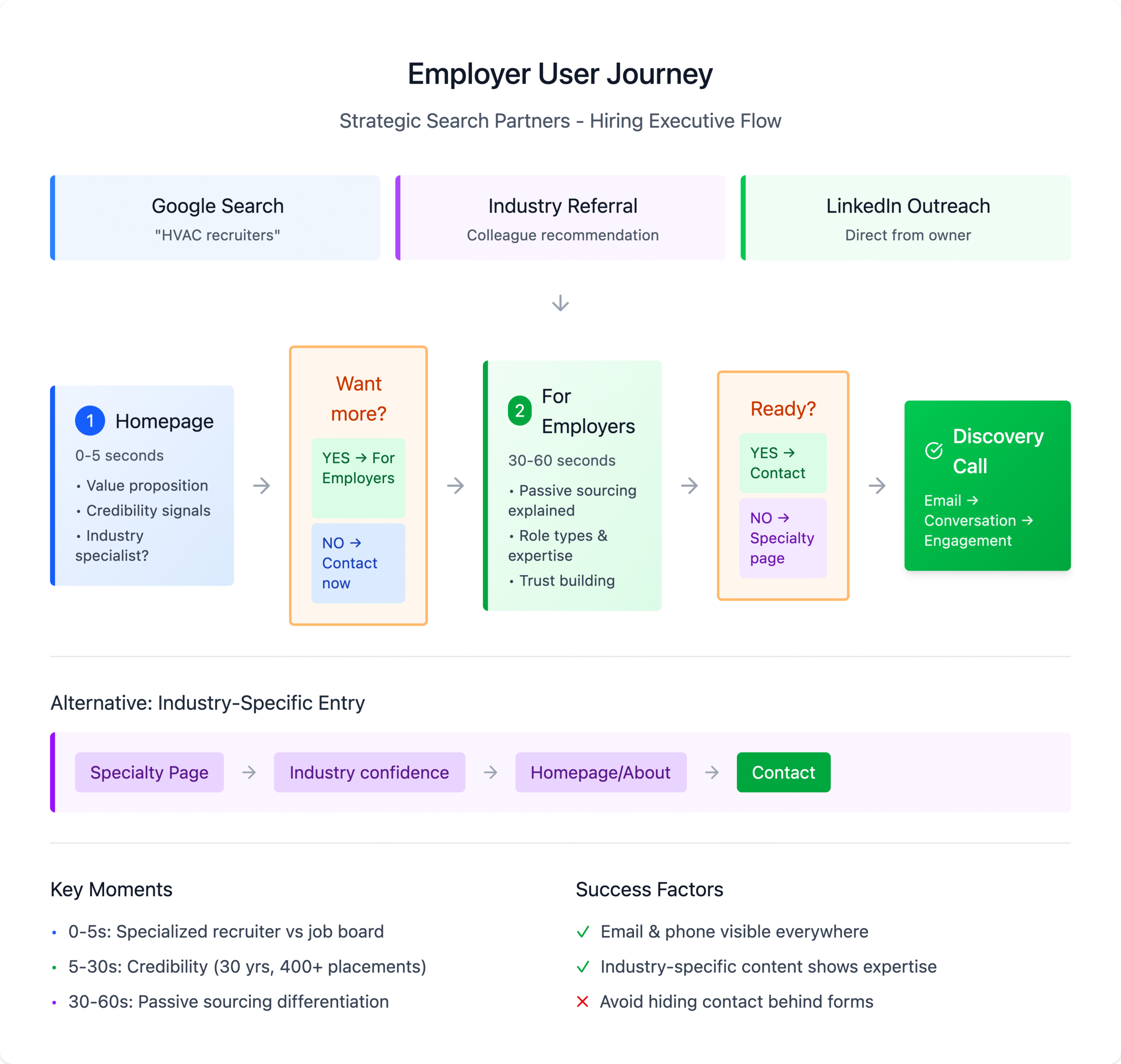
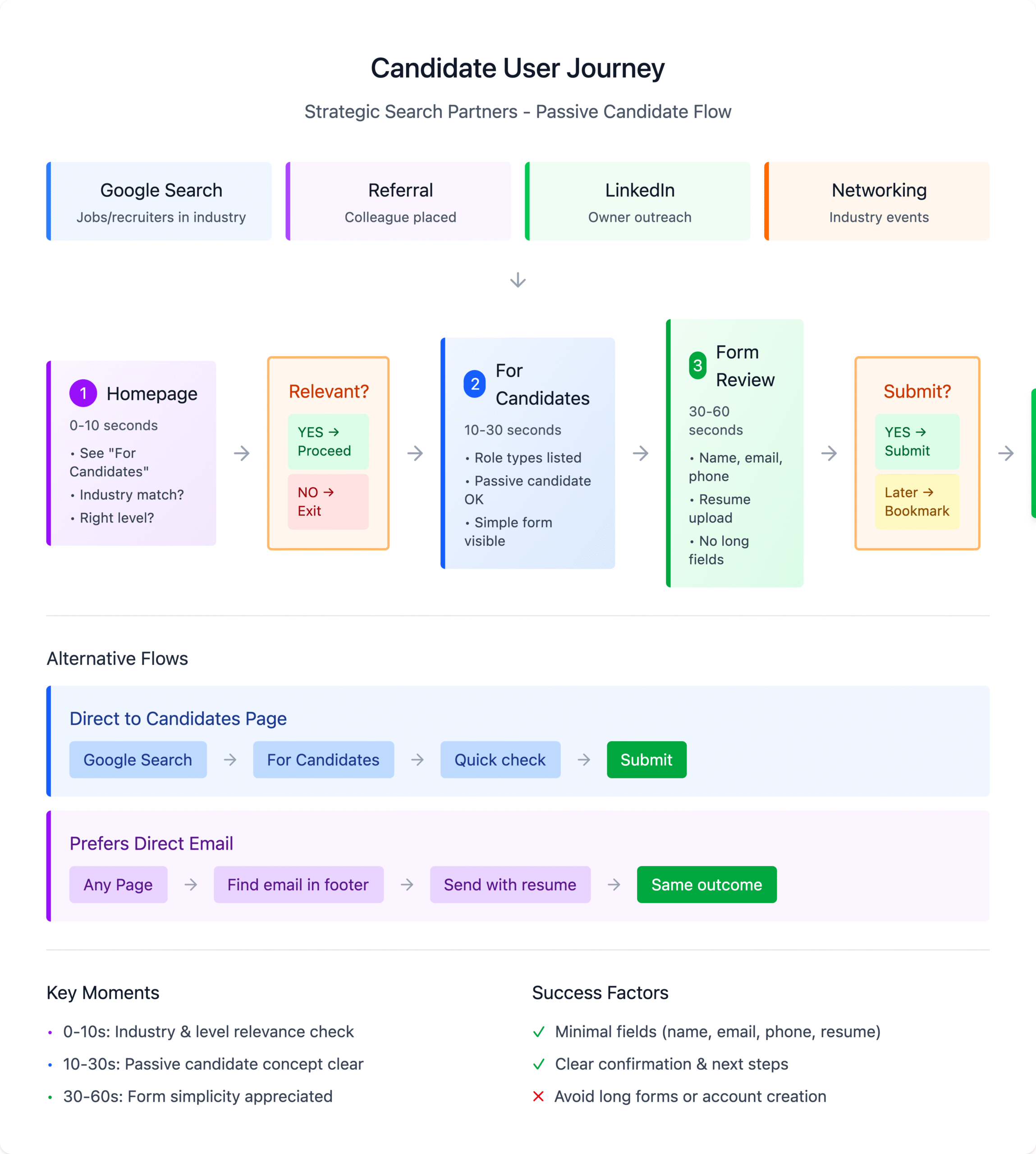
- Employer and candidate user flow diagrams
- Email-based contact system via FormSubmit
- Resume attachment support (PDF and Word)
- Copywriting across all pages and specialty sections
The specialty page strategy
Each page goes beyond a generic description — equipment terminology, role types, organizational structure, and specific search challenges for that segment.
The contact system
Candidate submission flow
- Name, email, phone, and resume attachment (PDF or Word)
- FormSubmit routes everything to the owner's inbox
- Confirmation message on successful submission
- Form validation on required fields
- No backend, no database, no third-party login required
Employer contact flow
- Direct email and phone on every page — no buried contact form
- No calendar tool — high-touch business calls for direct contact
- Employer page ends with a clear prompt to reach out
- All submissions drop into existing Outlook workflow unchanged
User flows
Homepage → expertise → reach out
Lands on homepage → sees passive sourcing differentiator and credibility stats → browses relevant specialty page → reaches out via email or phone to discuss hiring needs.
Homepage → candidates page → submit
Lands on homepage → follows "I'm Looking for Opportunities" CTA → fills out simple form with resume attached → receives confirmation → owner gets submission in inbox.
What I took away from this
Match the tool to the workflow
The email-based contact system wasn't a compromise — it was the right answer. The owner's workflow already works. The site's job was to plug into it, not replace it.
Niche expertise reads immediately
Using industry-specific terminology — chillers, AHUs, BMS, passive candidates — signals credibility faster than any about page. Speak the language of the audience and they trust you before they've read a single credential.
Simplicity is a design decision
Leaving out the ATS, the portal, and the scheduling tool wasn't a concession to budget. It was the correct product decision. Features that create maintenance burden and behavior change for a one-person operation have negative ROI.
Build timeline
Discovery & Research
Owner interviews, business model mapping, audience definition, technical constraints assessment, competitive analysis of boutique recruiting sites.
Architecture & Flows
Site map design, employer and candidate user flow diagrams, feature decisions (build vs. cut), specialty page strategy.
Copywriting & Visual Design
Page copy written with owner across all 12+ pages, visual direction, typography and color system, mockups for homepage and key templates.
WordPress Build & Launch
Full Kadence build, FormSubmit contact system, responsive QA across devices, owner walkthrough for independent updates, launch.
Live & Owner-Maintained Live
Owner updating content independently. No developer dependency. Tracking inbound leads from international search traffic.